The School at the Edge of the Ocean
Kerala, 1300–1600 CE
Stand at the mouth of the Periyar river on a clear December night and look south. The Arabian Sea is black and enormous, and the stars above it are very bright. In the fourteenth century, those stars were not merely beautiful — they were navigational instruments, agricultural calendars, and religious clocks, all at once. The fishing communities and Arab traders who worked this coast needed to know exactly where certain stars would be on certain nights, months from now. The farmers of the river valleys needed to know when the southwest monsoon would arrive, not approximately but precisely enough to plant at the right moment. The Hindu temples scattered across the Kerala countryside needed an accurate calendar — the exact lunar dates of festivals, the precise moments of astronomical conjunctions that carried ritual significance — and they needed it to be consistent from one generation to the next.
All of this created pressure for a level of mathematical precision that existing methods did not easily provide.
The man who began to build it was named Mādhava. He lived in a town called Sangamagrāma — generally identified with modern Irinjalakuda, in what is now Thrissur district, about seventy kilometres south of Kozhikode. The dates of his birth and death are uncertain: most scholars place him at roughly 1340 to 1425 CE. Almost none of his original writings survive. We know what he discovered primarily because his successors — a chain of brilliant students spanning two centuries — recorded his results in their own works, citing him as the source with the particular reverence that Indian scholarly tradition reserves for a founding teacher.
What Mādhava discovered, sometime in the late fourteenth century, was a crucial part of the foundation on which calculus would later be built. He is the earliest mathematician for whom we have clear evidence of a systematic use of infinite series — sums of infinitely many terms that converge to an exact finite value — in this context. He used infinite series to compute the value of π to eleven decimal places, a precision not matched in Europe for another two centuries. He derived infinite series expansions for the sine and cosine functions — series that in Europe are named after Newton and Gregory, who arrived at them 150 to 200 years later. He understood, at some level, what it means for an infinite process to converge, and he even developed correction terms for slowly converging series that show a real grasp of limiting behaviour.
He did all of this in the fourteenth century, in Malayalam and Sanskrit, on the Malabar coast of India, and the wider history of mathematics largely failed to notice it for centuries.
This chapter is the story of how and why.
The World Mādhava Inhabited
Before we can understand what Mādhava accomplished, we need to understand what he needed it for.
Kerala in the fourteenth century was not an isolated backwater. It was a central node in one of the most active trading networks in the world. The Malabar Coast was the primary source of black pepper for Europe and the Islamic world — a spice so valuable that it was sometimes used as currency. Arab, Jewish, Chinese, and later European merchant ships called at the ports of Calicut (Kozhikode), Cochin (Kochi), and Quilon (Kollam) in continuous rotation. The ancient port of Muziris, near Irinjalakuda, had been a major trading hub since at least the first century CE: Roman coins from the reign of Augustus have been found in the fields nearby.
This commercial activity made precise timekeeping and navigation critical. A ship’s navigator in the Arabian Sea needed to know the positions of stars — specifically, their angular elevation above the horizon at predictable times of night — to determine latitude and fix position. Errors in astronomical tables translated directly into navigational errors, and navigational errors meant ships lost at sea. The demand for accurate astronomical computation was not academic. It was economic and, for the sailors themselves, a matter of survival.
The Hindu astronomical tradition that Mādhava inherited — rooted in texts called siddhāntas going back to Āryabhaṭa in the fifth century CE — had already developed sophisticated methods for tracking planetary positions. But these methods had accumulated errors over centuries of use. They were based on approximations that were perfectly adequate for their time but increasingly inadequate as the demand for precision grew. The core problem was trigonometric: computing the positions of planets and stars requires accurate values of the sine and cosine functions, and the existing table-based methods could not provide sufficient precision.
To understand why this mattered so deeply to the Kerala astronomers, consider what a sine function actually is. If you have a circle of known radius and an angle measured from the centre, the sine of that angle gives you the ratio of the opposite side to the hypotenuse in the right triangle formed. For astronomical calculation, you need the sine of many different angles — not just the simple ones (30°, 45°, 60°) that have clean values, but arbitrary angles measured in degrees, minutes, and seconds. And you need these values accurately, because small errors in the sine values compound into large errors in the predicted positions of planets.
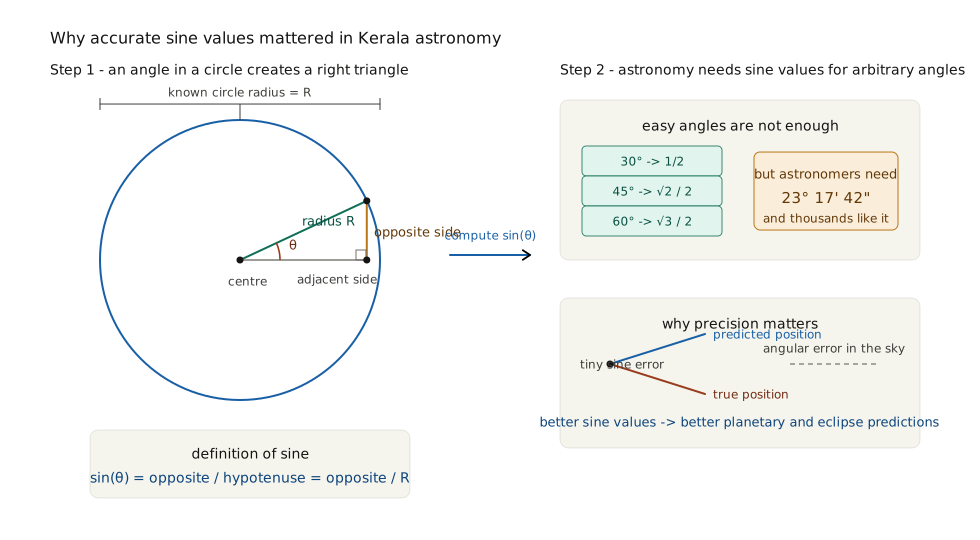
The traditional approach was to compute a table: calculate the sine of every angle at regular intervals (every 3.75 degrees was standard in the Indian tradition), and then interpolate between the table entries for intermediate angles. This works well enough if you only need a few decimal places of accuracy. But as the astronomical problems became more demanding — as people needed to predict the position of the moon to the nearest arcminute, to time an eclipse to within a few seconds — table-based methods hit a wall. You could make the tables finer, but the computation became impractical, and interpolation errors accumulated.
Mādhava’s breakthrough was to replace finite tables with infinite processes. Rather than looking up the sine of an angle in a table, he found a formula that could compute it to any desired precision from the angle alone — an infinite series that converges to the exact value. This was not just a more accurate method. It was a fundamentally different way of thinking about computation: not as looking up pre-computed values, but as following a procedure that homes in on a true answer with each additional step.
What an Infinite Series Is
Let us slow down here, because the concept of an infinite series is the intellectual heart of this chapter, and it deserves careful attention. This is harder than anything in the preceding chapters, and that difficulty is itself part of the story. What Mādhava did was genuinely hard. So far as the surviving record shows, no earlier tradition had articulated this mode of thinking in quite this way.
You already know what a finite sum is. Three plus five plus seven is fifteen. The terms end; the sum is exact; you’re done.
An infinite series is different. It is a sum that goes on forever:
\[ 1 - 1/3 + 1/5 - 1/7 + 1/9 - 1/11 + \dots \]The dots mean the pattern continues indefinitely, alternating between adding and subtracting the reciprocals of odd numbers. You can never write down all the terms, because there are infinitely many of them. And yet — and this is the miracle — if you add them up in order, the running total gets closer and closer to a definite value. It never arrives, but it converges. The limit, as mathematicians say, is \(\pi/4\).
Which means:
\[ \pi/4 = 1 - 1/3 + 1/5 - 1/7 + 1/9 - \dots \]Or equivalently:
\[ \pi = 4 \times (1 - 1/3 + 1/5 - 1/7 + 1/9 - \dots) \]One natural route to this series runs through the tangent function. For very small angles, measured in radians, \(\tan(\theta)\) is almost the same as \(\theta\) itself: the curve of the circle is so gentle, at a tiny scale, that the ratio defining the tangent differs only slightly from the angle. If you then ask for the inverse question — what angle has tangent \(x\)? — you are asking for \(\arctan(x)\), and the corresponding power series is:
\[ \arctan(x) = x - x^3/3 + x^5/5 - x^7/7 + \dots \]Now set \(x = 1\). The angle whose tangent is 1 is 45 degrees, or \(\pi/4\) radians, because in a right triangle with equal legs the opposite side and adjacent side are the same. So \(\arctan(1) = \pi/4\), and the series becomes exactly the one above. In effect, the geometry of a right triangle turns a question about tangent into a formula for \(\pi\).
This is the series now called the Madhava-Leibniz series for π — Leibniz rediscovered it in Europe in 1673, roughly three centuries after Mādhava. It is one of the most beautiful equations in all of mathematics: a number that seems hopelessly irrational and transcendental, the ratio of a circle’s circumference to its diameter, turns out to be related to the simplest possible pattern — the reciprocals of odd numbers, alternating in sign.
But beauty is not the point, at least not at first. The point, for Mādhava the astronomer, was precision. If you take the first hundred terms of this series, you get π accurate to about two decimal places. Take the first thousand terms, you get about three decimal places. This is frustratingly slow — the series converges, but it converges like a glacier moves. Mādhava was far too clever to just add up thousands of terms.
What he did instead was discover that you could add a correction term to any partial sum that dramatically improved its accuracy. Specifically, if you stop the series after n terms, the error is approximately the next term — but a slight adjustment to that next term gets you much closer than the naive estimate. Mādhava found these correction terms and used them to compute π to eleven, and possibly thirteen, correct decimal places. The method was so efficient that it represents the most accurate calculation of π produced anywhere in the world up to that point in history.
Think about what thirteen decimal places means. It means:
\[ \pi \approx 3.1415926535898 \]The difference between this and the true value of π is about 0.000000000000007. If you used this value to calculate the circumference of the entire Earth, your error would be less than the width of an atom.
Mādhava did this in the fourteenth century, by following a mathematical pattern whose logic he had to invent from nothing.
The Series That Changed Everything
The series for π is remarkable, but it is Mādhava’s series for the sine and cosine that are most important for the history of calculus. These are the series that Newton and Gregory would rediscover in Europe in the 1660s and 1670s, and that now appear in every calculus textbook as the defining property of these functions.
For a reader encountering them for the first time: the sine and cosine of an angle can be expressed as infinite sums of powers of the angle, divided by factorial numbers. In modern notation:
\[ \sin(\theta) = \theta - \theta^3/3! + \theta^5/5! - \theta^7/7! + \dots \] \[ \cos(\theta) = 1 - \theta^2/2! + \theta^4/4! - \theta^6/6! + \dots \]where θ is measured in radians, and n! means n factorial (1 × 2 × 3 × … × n).
These are power series. For any angle θ, you can compute its sine or cosine to any desired accuracy by taking enough terms. Unlike the table-based approach, there is no limit to the precision you can achieve, and unlike brute computation, the series converges quickly for small angles — a few terms gives excellent accuracy.
The Yuktibhāṣā of Jyeṣṭhadeva — a remarkable text written around 1530 CE in Malayalam, one of the first major mathematical works in that language — contains a full derivation of these series, attributed to Mādhava, with derivations that many historians judge strikingly rigorous for their time. The derivation uses what amounts to infinitesimal analysis: dividing the arc of a circle into a large number of small pieces, computing the sine and cosine of each piece using approximations that become exact in the limit as the pieces become infinitely small, and then summing the contributions. This is, in its essential structure, integration — the core operation of calculus — applied a century and a half before Newton.
Jyeṣṭhadeva describes Mādhava’s sine series in the following way, in a passage that has been carefully translated from the original Malayalam:
“The arc is to be repeatedly multiplied by the square of itself and is to be divided by the square of each even number increased by itself and multiplied by the square of the radius. The arc and the terms obtained by these repeated operations are to be placed in a column and added and subtracted alternately.”
This is the series. Written in the formal mathematical language of a later era, it is exactly Newton’s sine series. Written in fourteenth-century Kerala, in the vernacular language of the region, as a practical procedure for computing astronomical tables.
The School and Its Chain
Mādhava was not alone. One of the most distinctive features of Kerala mathematics was its institutional structure: the guru-śiṣya paramparā, the chain of teacher to student to student’s student, stretching across generations. This was not unusual in the Indian scholarly tradition, but the Kerala chain had an unusual density of genuine mathematical talent, and an unusual commitment to building systematically on what came before.
Mādhava’s most important direct student was Parameśvara (c. 1380–1460), who was based at Āśvattagrāma, about fifty kilometres northeast of Mādhava’s hometown. Parameśvara was an observational astronomer of the first order: he made systematic observations of lunar and solar eclipses over a period of fifty-five years, a programme of empirical data collection that was essentially scientific in its character. He used these observations to improve planetary models and develop a new computational system called the Dṛggaṇita (literally, “calculation by observation”), which brought the theoretical models into better agreement with what was actually seen in the sky. He also contributed an important result to pure mathematics: an early version of the mean value theorem, a foundational result in calculus that would not appear in European mathematics until the seventeenth century.
Parameśvara’s student Nīlakaṇṭha Somayāji (1444–1544) was perhaps the most intellectually ambitious figure in the school. He lived to the extraordinary age of about one hundred, and he used the time well. His major work, the Tantrasamgraha (c. 1500 CE), is a comprehensive treatise on mathematical astronomy that, among other things, contains a revised planetary model anticipating certain features of the Copernican heliocentric system — published, note, about forty-five years before Copernicus’s De revolutionibus appeared in Europe. Nīlakaṇṭha did not adopt heliocentrism outright, but he recognised that the motion of the inner planets (Mercury and Venus) was most naturally described by having them orbit the sun rather than the earth, producing a hybrid model sometimes called “geo-heliocentric.” It is a remarkable anticipation that has received almost no attention in the Western history of astronomy.
Nīlakaṇṭha also wrote extensively on the foundations of mathematics, including a careful discussion of what it means for an infinite series to converge — a discussion that, in its clarity and rigour, was not matched in Europe until the nineteenth century.
The chain continued through Jyeṣṭhadeva (c. 1500–1575), whose Yuktibhāṣā is the most important surviving text of the Kerala school; through Śankara Vāriyar (c. 1500–1560), whose commentary on the Tantrasamgraha is another crucial source; and through Achyuta Piśāraṭi (c. 1550–1621), who extended the work of his predecessors into new domains of spherical geometry. The school continued to produce important work until at least the early nineteenth century, when Sankaravarman, the Raja of Kadattanadu, wrote the last significant text of the tradition, the Sadratnamāla, in 1819 CE.
Five centuries of continuous mathematical activity, in a single regional tradition, producing results that were — in several cases — centuries ahead of their European equivalents.
The Longitude Problem, and Why It Matters
To understand why the Kerala school was so productive, and why its productivity was so focused on infinite series and trigonometry, it helps to understand the specific astronomical problem that drove it.
The hardest problem in pre-modern astronomy was computing the longitude of the moon at an arbitrary moment in time. The moon’s orbit is irregular — it speeds up and slows down in a complicated way as it moves closer to and farther from the earth, and this variation is further complicated by the gravitational influence of the sun. Getting the moon’s position right requires not just the basic orbital model but a series of corrections, each one requiring trigonometric computation. And the moon moves fast: an error of one arcminute in the moon’s predicted position corresponds to a timing error of about two seconds in the prediction of a lunar eclipse.
In the Hindu calendar, lunar eclipses were ritually significant events whose timing had to be calculated months or years in advance and announced publicly. Getting the prediction wrong was not merely an embarrassing technical failure — it undermined the authority of the astronomical tradition and, by extension, of the religious and scholarly institutions that depended on it. The pressure to compute accurately was intense.
This is what Mādhava was solving. The sine and cosine series were not mathematical playthings. They were tools for computing, with unprecedented precision, the trigonometric functions that appeared in the equations of planetary motion. Every extra decimal place of accuracy in the sine table translated directly into a more accurate prediction of where the moon would be next month, and when the eclipse would start.
The connection to navigation is equally direct. Arab and Indian sailors navigating the Arabian Sea used the angular elevation of the Pole Star to determine their latitude. Calculating the corrections needed to extract the true north from the observed position of a star requires — again — precise trigonometric values. The port of Kochi was one of the most important entrepôts in Asia in this period, and the mathematical astronomers of the Kerala tradition were embedded in the same coastal society that produced and relied upon this navigation. They were not isolated scholars. They were part of the practical world.
The Lost Credit
In 1671, a Scottish mathematician named James Gregory derived the infinite series for the arctangent function:
\[ \arctan(x) = x - x^3/3 + x^5/5 - x^7/7 + \dots \]Setting x = 1 gives arctan(1) = π/4, which produces the series for π. This result became known as the Gregory-Leibniz series after Leibniz independently derived the same result in 1673. It was considered one of the great achievements of seventeenth-century European mathematics.
In the 1660s, Isaac Newton derived the series for sin(x) and cos(x) — the same series that appear in Mādhava’s work, attributed to him in multiple Kerala texts that predate Newton by 150 to 200 years.
In 1834 — more than four hundred years after Mādhava’s death — a British mathematician named Charles Whish published a paper in the Transactions of the Royal Asiatic Society of Great Britain and Ireland drawing attention to four Kerala texts that contained these infinite series and explicitly predated the European work. The paper was read, noted, and largely forgotten. The scholarly machinery of nineteenth-century Europe was not prepared to revise the narrative of mathematical history on the basis of texts from the Malabar coast, and Whish died before he could develop the argument further.
The rediscovery came again in the mid-twentieth century, through the work of C.T. Rajagopal and his collaborators in Madras, who published careful analyses of the Kerala texts in the 1940s through 1970s. Their work was taken seriously but remained largely confined to specialists. It was not until the 1990s and 2000s — with the full English translation of the Yuktibhāṣā published in 2008, and a growing body of scholarly work by historians including George Gheverghese Joseph, Kim Plofker, and David Mumford — that the Kerala school’s priority began to be acknowledged in mainstream histories of mathematics.
Even now, the acknowledgment is partial. Most popular histories of calculus still begin with Newton and Leibniz. The series still bear Gregory’s and Leibniz’s names in most textbooks. The name “Madhava-Leibniz series” and “Madhava-Newton series” — which some mathematicians now use — has not yet made it into standard curricula.
This is not simply an injustice to Mādhava personally. It is an impoverishment of the history of mathematics as an intellectual story. The Kerala school’s achievements demonstrate something profoundly important: that the conceptual tools required for calculus — infinite series, convergence, infinitesimal analysis — arose independently in a non-European context, driven by practical problems in astronomy, roughly two centuries before they arose in Europe. This parallel development is exactly the kind of evidence that shows us how mathematical ideas are genuinely universal — not the property of any particular culture, but the inescapable consequence of asking certain kinds of questions about the world with sufficient persistence and rigour.
The Transmission Question
There is a further question that historians have debated with some heat: did the Kerala school’s discoveries reach Europe, and influence the development of calculus there?
The circumstantial case is suggestive. Kochi was a major port in the fifteenth and sixteenth centuries, and after Vasco da Gama’s arrival in 1498, it became the primary hub of Portuguese trade in Asia. Jesuit missionaries established a presence in Kerala in the sixteenth century, and some of them — notably Matteo Ricci — were trained mathematicians who engaged seriously with local scientific traditions. The Jesuit college at Kochi collected manuscripts. Trade routes between Kerala and Europe, direct or via the Persian Gulf and the Levant, were active and well documented. The chronology is compatible: the relevant Kerala texts were known and circulating in the region precisely in the period when Jesuit and Portuguese contacts were most intense.
George Gheverghese Joseph, the University of Manchester mathematician who has written most extensively on this question, argues that transmission is plausible and deserves serious investigation. Kim Plofker, a leading historian of Indian mathematics, is more cautious, noting that no direct documentary evidence of transmission has been found — no European text that cites a Kerala source, no letter that describes reading a Malayalam mathematical manuscript.
The candid answer is that we do not know. What we do know is that, in the surviving textual record, these ideas appear in Kerala well before their European rediscovery. Whether they also reached Europe through some channel we have not yet identified is a separate and, for the history of mathematics as intellectual achievement, secondary question. Newton’s and Leibniz’s genius is not diminished by acknowledging that someone else had the same ideas first; the history of science is full of independent parallel discoveries. What is diminished, when we ignore the Kerala school, is our understanding of how and why these ideas arose — the full, accurate, global story of how humanity learned to tame the infinite.
What the Mathematics Actually Says
Let us return to the mathematics one more time, because there is a depth to it that deserves acknowledgment.
The series for π, beautiful as it is, converges too slowly to be useful in computation without Mādhava’s correction terms. And those correction terms are, in a technical sense, the most impressive part of his achievement. A correction term is not just a patch on a slow computation — it reflects a genuine understanding of the error in a partial sum, which requires understanding the behaviour of the series in the limit, which requires thinking about infinity with precision.
Mādhava’s three correction terms for the π series, analysed by modern mathematicians, turn out to correspond to continued fraction approximations that anticipate results not formally established in European mathematics until Euler in the eighteenth century. Whether Mādhava arrived at them by formal reasoning or by inspired guesswork is, frankly, impossible to determine from the surviving texts. What is clear is that they are correct, and that their correctness is not obvious — they are not the kinds of things you stumble on by accident.
The Yuktibhāṣā’s derivation of the sine series is similarly deep. Jyeṣṭhadeva’s proof — which he attributes the method to Mādhava — works by dividing the arc of a circle into n equal parts, computing the contributions of each part, and then taking the limit as n goes to infinity. The technical machinery for limits that European mathematicians would develop in the seventeenth and eighteenth centuries is not present in full generality in the Yuktibhāṣā — but the practice of taking limits, of considering what happens as a quantity becomes infinitely large or infinitely small, is demonstrably there. The concept precedes the formal theory by two centuries. That is entirely normal in the history of mathematics: precise practice usually runs ahead of precise language, and the language eventually catches up.
Fields Medallist David Mumford — one of the leading mathematicians of the twentieth century — wrote in 2010 that it “seems fair” to describe the Kerala work as a genuine independent discovery of core ideas of calculus, and that Mādhava “should be seen as among the earliest known mathematicians to have glimpsed ideas that Newton and Leibniz later developed into a formal theory.” That assessment, from a mathematician of Mumford’s stature, carries weight.
A Question Worth Sitting With
Why didn’t the Kerala school change the world the way Newton and Leibniz did?
This is a genuinely difficult question, and it deserves a genuinely candid answer.
Part of the answer is geographical and linguistic. The Kerala school wrote in Malayalam and Sanskrit — languages that had no significant readership in the emerging scientific community of sixteenth and seventeenth-century Europe. The texts were not translated. The port of Kochi, however busy, was a trading hub, not a centre of European intellectual exchange. Ideas that might have spread rapidly through the Latin correspondence networks of European scholars — through letters between mathematicians in Paris, London, Amsterdam, and Bologna — could not travel the same way from the southwestern tip of India.
Part of the answer is institutional. The Kerala tradition was embedded in a guru-śiṣya structure — knowledge passed orally from teacher to student, with written texts functioning as supplements to oral transmission rather than as the primary vehicle. This is a beautifully robust way to preserve knowledge within a community, but it does not spread ideas beyond the community in the way that printed books did in post-Gutenberg Europe. The Yuktibhāṣā was written in Malayalam, the regional language of one state of India, at a time when the printing press had already begun its transformation of European intellectual life. It remained a manuscript, known to a small scholarly community in Kerala, until the twentieth century.
Part of the answer is, frankly, about what happened next in Europe. Newton and Leibniz did not only discover infinite series and the sine and cosine expansions. They also developed a general framework — the differential and integral calculus — that could handle arbitrary functions, not just trigonometric ones. They created a notation (Newton’s fluxions, Leibniz’s dx and dy notation) that made the ideas manipulable and generalisable in new ways. The Kerala mathematicians were working within an astronomical context that naturally focused their attention on circular and trigonometric functions. The surviving Kerala texts do not make the later European leap to a calculus of arbitrary functions, and so the work remained a set of powerful but still specialised tools rather than a fully general theory.
This is not a criticism. It is a description of what happens when mathematical discovery is tightly coupled to a practical problem. The practical problem — precise astronomical computation — was solved brilliantly. The general theory that transcended the problem was not developed. Europe, for reasons partly institutional, partly historical, and partly lucky, developed both.
None of this diminishes what Mādhava achieved. He stood at the bank of the same river that Newton and Leibniz would later cross, and he waded in first. He saw the infinity, understood it was navigable, and built the first boats.
The Tradition That Never Quite Ended
The Kerala school of mathematics did not simply stop. It continued to produce important work well into the seventeenth and eighteenth centuries, even as European mathematics was racing ahead on the foundations of Newtonian calculus. Achyuta Piśāraṭi worked on spherical geometry and planetary models. Later scholars refined and extended the astronomical tables. The tradition of careful observational astronomy and the associated mathematical analysis continued in Kerala long after the intellectual centre of gravity for mathematics had shifted westward.
The final significant text of the tradition, Sankaravarman’s Sadratnamāla, was written in 1819 — by which point Newton had been dead for nearly a century, Laplace’s Mécanique céleste had already been published, and the industrial revolution was underway in England. The Sadratnamāla contains correct results in trigonometry and series that were, by then, long established in European mathematics. It is a poignant document: a great tradition arriving, in its own terms, at conclusions that the wider world had already moved past.
But this is the wrong way to read it. The Kerala school’s achievement is not diminished by the fact that Europe eventually developed a more general framework. Five centuries of continuous mathematical activity, driven by genuine practical need and genuine intellectual curiosity, produced results of the first order. The sine series. The cosine series. The series for π. The correction terms. The mean value theorem. Early heliocentric planetary models. A proof-based mathematical treatise written in Malayalam — the first of its kind in that language — that stands as a landmark in the global history of mathematics.
These things happened on the Malabar coast of India, between the fourteenth and seventeenth centuries, under a green canopy of coconut palms and jackfruit trees, to the sound of the Arabian Sea.
They happened because people needed to know where the moon would be next Tuesday.
What the School at the Edge of the Ocean Tells Us
The Kerala school forces us to revise not just a list of names and dates but the underlying story we tell about mathematics.
The standard narrative has mathematics evolving from Greece to Alexandria to the Islamic world to Renaissance Europe, with the major breakthroughs happening along that single corridor. In this story, non-European mathematical traditions are either primitive predecessors (the Babylonians, the Egyptians) who provided raw material that the Greeks refined, or transmission agents (the Islamic world) who preserved and passed on the Greek inheritance. India appears briefly, for the gift of zero and the decimal system, and then disappears from the main narrative until the twentieth century.
The Kerala school does not fit this story. It is not a predecessor, not a transmission agent, not a brief contributor. It is a centre — a place where, independently and in parallel with the most important mathematical development in European history, a group of brilliant people worked their way to the edge of calculus and peered over.
The reason it has been excluded from the standard narrative is not mathematical. The surviving dates, texts, and technical sophistication are strong enough that the Kerala contribution can no longer be treated as marginal. The reason is linguistic, institutional, and — let us be frank — colonial. The history of mathematics as a discipline was largely written in the nineteenth century, by European scholars, in European languages, drawing primarily on European sources. The Kerala texts were in Malayalam and Sanskrit, known to a small community of specialists, not translated until the late twentieth century. They fell outside the field of vision of the people who wrote the standard histories, and the standard histories became entrenched.
Correcting this does not require any exaggeration of the Kerala achievement. It requires only accuracy. Mādhava discovered the infinite series for π and the trigonometric functions before Newton and Gregory. The Yuktibhāṣā contains a proof-based treatment of infinite series that precedes the systematic European development of these ideas by more than a century. The case is increasingly well supported in the modern historiography, even though some questions of transmission and framing remain debated.
They belong in the story. They change the story. They make it better — richer, truer, more candid about the way mathematical ideas actually develop: not in a single corridor, but across the whole breadth of human curiosity, wherever people face hard problems and refuse to give up on them.
In the next chapter, we leave the Indian Ocean coast and travel to Europe, where the gunpowder revolution of the fifteenth and sixteenth centuries was creating its own urgent demand for new mathematics. The problem of how to aim a cannonball — how to predict the arc of a projectile through air — would pull a new generation of mathematicians toward exactly the same questions that Mādhava had been wrestling with from the other direction. They would not know that someone had already been there.