Everything so far has treated instruments abstractly — a “melody instrument,” a “bass,” four “voices” — but to write convincingly for real players, and to orchestrate in Part 7, you need to know the instruments themselves: how each makes its sound, where it lives in pitch, and what it does well. Part 6 is that practical primer. It will not turn you into a professional orchestrator — that is a lifetime’s study — but it will give you the working knowledge to write idiomatically for the common instruments and to combine them without disaster. We begin with the big picture: the four families into which the orchestra’s instruments divide, grouped by how they produce sound.
31.1The four families
Instruments are grouped into four families — strings, woodwinds, brass, and percussion — and the grouping is not arbitrary: members of a family make their sound the same way, so they blend naturally with one another and share a related character. The families also occupy overlapping but distinct regions of pitch, from the double bass and tuba rumbling far below to the piccolo and glockenspiel glittering above. This chart maps the common instruments by family and range, and it is worth returning to often:
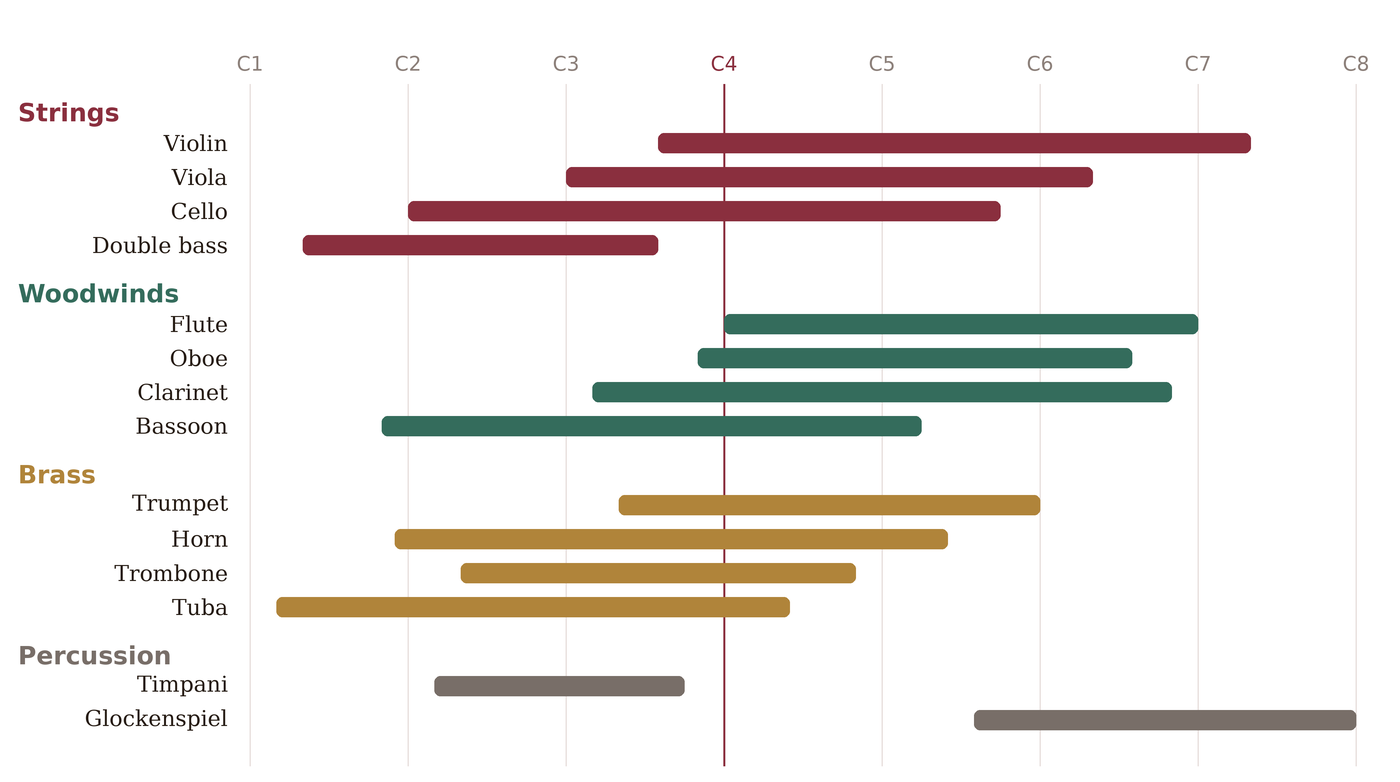
Study Figure 31.1 and two patterns emerge. First, each family is a choir in itself — it has its own high, middle, and low members (violin down to double bass; flute down to bassoon; trumpet down to tuba), so a family alone can cover full four-part harmony. Second, the families overlap in register, which is what makes orchestration an art of colour: a middle-C melody could be played by a violin, a clarinet, or a horn, and the choice is one of timbre, not necessity. The rest of this chapter takes the families one at a time.
31.2Strings
The string family — violin, viola, cello, and double bass — is the heart of the orchestra, and the most versatile and blendable of all. The sound is made by drawing a bow across a stretched string (arco), or by plucking it with a finger (pizzicato); the four instruments are the same design at four sizes, from the small, brilliant violin to the huge, growling double bass. Strings can sustain a note indefinitely and shape it with infinite gradation — swelling, fading, sliding, trembling — which makes them supremely expressive and the ideal foundation for almost any texture. They blend seamlessly with one another (a string section sounds like one rich instrument) and support every other family. If the orchestra has a default sound, it is the strings; they are where most orchestration begins.
31.3Woodwinds
The woodwind family — flute, oboe, clarinet, and bassoon, with cousins like the piccolo and cor anglais — makes its sound by setting a column of air vibrating inside a tube, and how the air is set going gives each a distinct voice. The flute is blown across an edge, like a bottle, and sounds pure and silvery. The oboe and bassoon use a double reed (two blades of cane beating together) for a reedy, plaintive, characterful tone. The clarinet uses a single reed against a mouthpiece, giving it a smooth, woody sound and the widest range of the four. Unlike the strings, the woodwinds do not blend into one anonymous mass — each keeps its own colour, which is exactly their value: a woodwind is how you give a melody a specific, recognizable character, and a wind solo stands out against strings like a distinct voice in a crowd. They are agile, too, capable of rapid runs and leaps.
31.4Brass
The brass family — trumpet, horn, trombone, and tuba — produces sound by the player buzzing their lips into a cup-shaped mouthpiece, the length of tubing (changed by valves, or by the trombone’s slide) selecting the pitch. Brass is the orchestra’s power: at full volume it is the loudest, most brilliant and commanding sound available, capable of blazing fanfares and crushing climaxes. But it is not only loud — played softly, the horn is noble and mellow, the trombone solemn, and the whole family can whisper as well as roar. A mute placed in the bell changes the colour, muffling or sharpening the tone. Brass adds weight, brilliance, and grandeur; used sparingly it is thrilling, and used constantly it overwhelms, so it is the family a beginner most often over-uses.
31.5Percussion
The percussion family is everything you strike, and it splits in two. Pitched percussion — the timpani (tunable kettledrums), plus the glockenspiel, xylophone, and marimba — plays definite notes and can carry harmony or melody, glittering (the metal instruments) or woody (the wooden ones). Unpitched percussion — the snare drum, bass drum, cymbals, triangle, and countless others — has no definite pitch and instead supplies rhythm, colour, accent, and climax: the crack of a snare, the crash of a cymbal, the thud of a bass drum. Percussion is the orchestra’s punctuation and its muscle. A little goes a long way; a well-placed cymbal crash at a climax is worth more than a page of constant drumming.
31.6How the families combine
The orchestra is these four families deployed together, and the broad logic of combining them is simple to state. The strings are the foundation and the default — most textures rest on them. The woodwinds add distinct solo colours and inner voices. The brass supplies power and weight at climaxes and grandeur in sustained harmony. The percussion punctuates, accents, and drives rhythm. Within a family, instruments blend; between families, they contrast — which is why doubling a melody in violins and a flute enriches it (blend across families in the same register), while a brass fanfare answered by strings sets one colour against another (contrast). All of orchestration, in the end, is the art of choosing which family, which instrument, which register carries each strand of the music — and the following chapters give you the practical detail to do it: the ranges and transpositions (Chapter 32), where each instrument sounds its best (Chapter 33), and how to combine them cleanly (Chapter 34).
In MuseScore
MuseScore knows every instrument in these families — their ranges, their clefs, and their sounds — which makes it an ideal place to get acquainted with them.
- Browse the instruments via File ▸ New or Add ▸ Instruments (I): they are organized by family, each with its correct clef and playback sound. Add one and enter a few notes to hear it.
- See the ranges as you write: MuseScore colours notes red (or yellow, at the edges) when they fall outside an instrument’s playable range — an instant check that you are writing something a real player can manage.
- Hear the colours with the built-in sounds, or download MuseSounds (free) for far more realistic timbres — the difference between a flute and an oboe on the same melody becomes obvious.
- Try the Mixer (F10) to solo and compare instruments.
Try it: enter a simple melody — the running tune, or any of your own — and copy it onto four different instruments, one from each family: a violin, a flute, a trumpet, and a marimba. Play each in turn. The notes are identical; the character is utterly different. That difference is the raw material of orchestration, and hearing it firsthand is the whole purpose of this chapter.